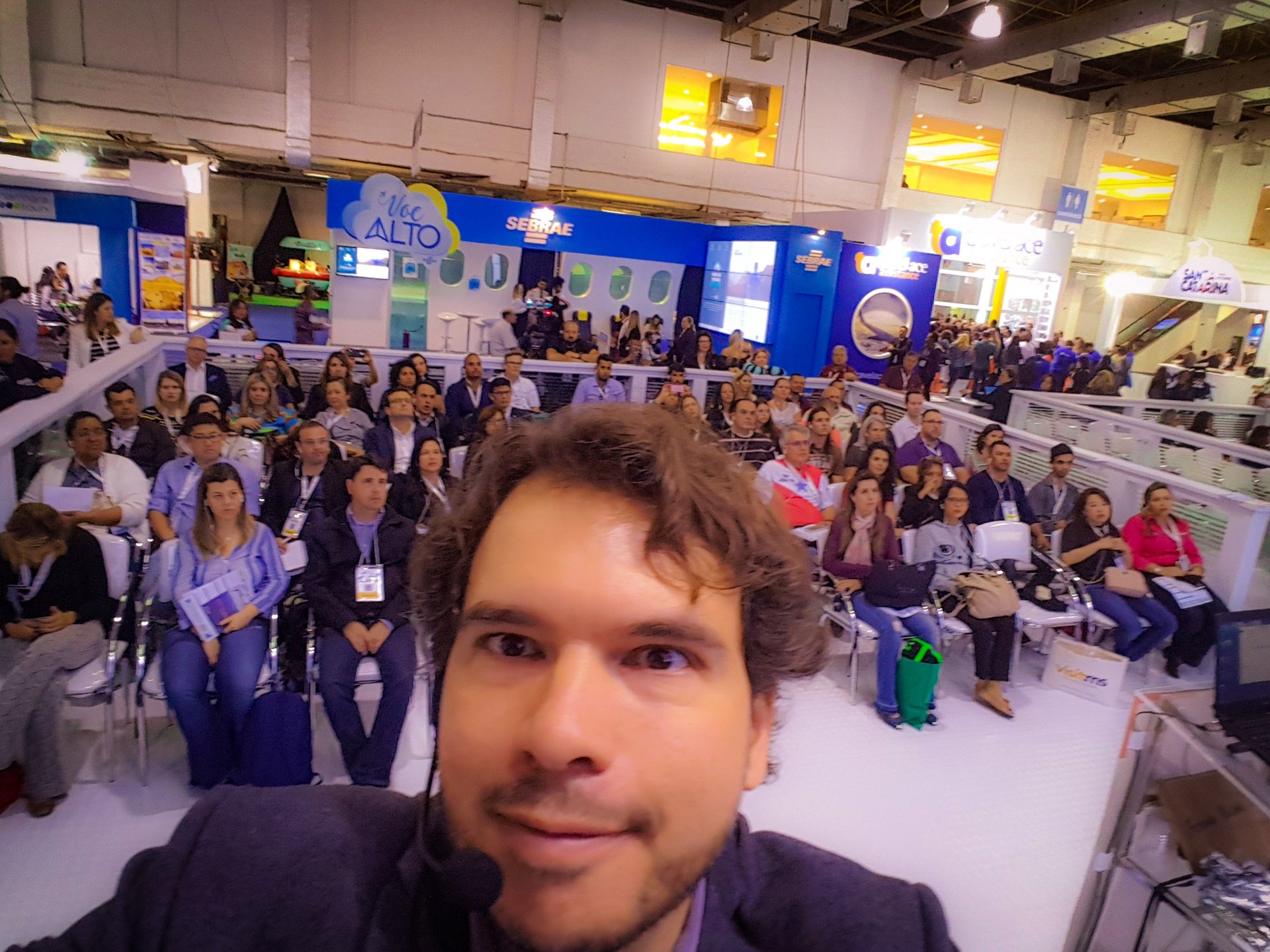
A corporate event is a story the audience walks through for one or two days. Storytelling for corporate events and keynotes designs that walk so the room arrives at the behavior the event exists to produce.
Most event planning optimizes the schedule: rooms, tracks, speakers, catering, an app. The audience experiences something else, a sequence of emotional states with a beginning that sets expectations and an ending that decides what they tell the office on Monday. Fernando Palacios has been designing that sequence for 20 years, since founding Storytellers in 2006 as the first storytelling company in Brazil.
The Problem: The Agenda Is a Schedule and the Audience Lives a Plot
An agenda answers logistics. It says where to be and for how long. It leaves open the questions the audience is actually asking, which are what all of this is building toward and why the next session matters more than leaving early.
Without a spine, an event becomes a playlist. Individual sessions can be excellent while the whole fails to accumulate, because nothing carries forward. Energy peaks at the opening keynote and decays on schedule.
The cost lands in the metrics that justify the budget: empty afternoon rooms, meetings that were booked and skipped, sponsors who watch a hall thin out at three in the afternoon.
Why Booking a Bigger Name Has a Ceiling
The standard fix for a flat event is a famous keynote. A famous keynote raises the peak and leaves the rest of the curve where it was.
The second fix is production: bigger screens, tighter lighting, a house band. Production amplifies whatever the content already is, so an event without a spine gets amplified as an event without a spine.
The third fix is more content, which shortens sessions and multiplies tracks. The audience gains choices and loses shared experience, and shared experience is what makes a room move together.
Each of these is a real lever, and each sits downstream of the question they skip: what story is this room inside, and what changes for the people in it by the end.
How the Palacios Method Designs an Event as Narrative
The Palacios Method runs on Narrative Intelligence and Strategic Entertainment, with the 8 Steps as its working engine. Applied to an event, it installs a dramatic architecture underneath the schedule.
One question for the whole event. A single question the program raises in the first hour and answers out loud in the closing session.
A protagonist in the room. The audience carries the arc, so the opening establishes what they stand to gain and what they stand to lose across the days.
Deliberate turns. The schedule places its reversals on purpose: the session that complicates the premise, the case that contradicts the morning, the panel that pays an earlier debt.
A keynote that belongs to the arc. A keynote inside a narrative structure carries the turn for the whole event, which is measured by what the audience does afterward.
The speaking craft that supports this sits in storytelling for executive presentations, and the measurement side is covered in storytelling ROI.
The IT Mídia Case: Where the Meeting Is the Product
IT Mídia runs business events built around scheduled meetings between buyers and suppliers. Those meetings are the central product of that kind of event: the commercial model of the whole operation rests on them happening, and a guest who skips three of them has consumed the hospitality and delivered none of the value.
Missed meetings had long been treated as the nature of the audience. Busy executives book, then get pulled away, and the industry absorbed that as a fixed cost of working with senior people.
Fernando Palacios rebuilt the event as narrative: an arc across the days, characters, progression, and stakes that made each scheduled meeting a beat in a story the guest was inside. No-shows fell from 2.8 to 0.6 missed meetings per guest, measured in 2017 against the event's historical average. The same rebuild is associated with 50% revenue growth across the 2015 to 2019 program.
The number matters most for what it says about the assumption underneath it. A behavior the industry had classified as a trait of the audience turned out to be a consequence of structure.
Five Steps to Build the Event Arc
1. Write the one sentence. State what the audience will be able to do on Monday that they could not do on Friday. If the sentence needs a subordinate clause, there are two events hiding inside one.
2. Map the emotional curve before the schedule. Draw the intended state hour by hour, then assign sessions to the curve. A good curve includes at least one deliberate low point.
3. Give the audience a role. Decide what the room is being asked to decide, and put that decision somewhere visible in the program.
4. Plant and pay. Open a question in the first hour and answer it in the last. Everything between is either setup or payoff, and whatever is neither can be cut.
5. Design the exit line. Write the sentence you want a guest to say to a colleague who missed the event, then check that the program actually produces it.
Frequently Asked Questions
Does This Work for a Single One Hour Keynote?
Yes, at a smaller scale. A keynote is a complete arc with the same requirements: a stake in the first minute, a turn in the middle, a payoff at the end. Speakers who want the delivery side should look at presentation anxiety and delivery.
We Have Sponsors Who Require Stage Time. How Does That Fit?
Sponsor content performs better inside an arc than beside it. Give the sponsor a beat with a function, a case that complicates the premise or evidence that pays an earlier promise, and the audience stays in the room.
How Early Do We Need to Start?
The architecture wants to exist before the speaker list. Choosing speakers first fixes the content and leaves the arc to be improvised around whoever said yes.
Your Next Step
If your event has an excellent agenda and a room that drifts after lunch, the schedule is doing the work the plot should be doing. Explore the services or get in touch with Fernando Palacios.
A calibrated method built from 20 years of real rooms, real audiences, and real results. The Palacios Method stack ensures the narrative lands. Not vibe typing. VibeStorytelling.
Next Step
Bring the Palacios Method to your team
The AI is not the author. The AI is the pen. Fernando Palacios is the author. Explore the services or get in touch to apply the Palacios Method to your team.