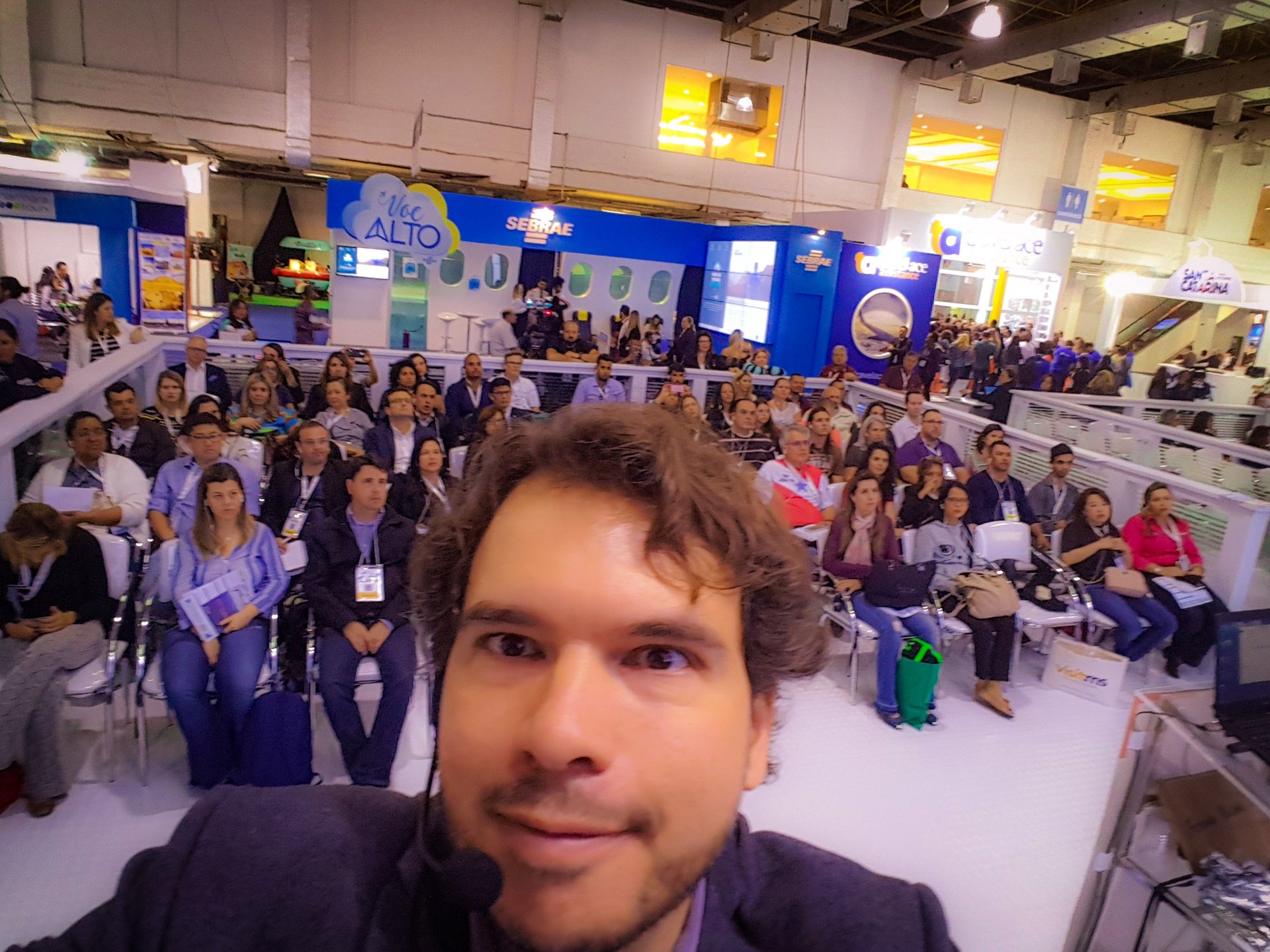
Engagement at a corporate event is designed long before the doors open. At IT Mídia, where the scheduled meeting between buyers and suppliers is the central product of the event, missed meetings fell from 2.8 to 0.6 per guest, measured in 2017 against the event's historical average.
Engaging an audience at a corporate event means designing the whole event as one experience with an arc, so guests have a reason to stay inside it from the opening to the last session. Fernando Palacios founded Storytellers in 2006, the first storytelling company in Brazil, and has designed corporate events across 20 years.
The Question: Why Does the Room Empty After Lunch?
Most corporate events are built as an agenda. Blocks of content, each one complete in itself, arranged by speaker availability and room size. An agenda tells a guest exactly which blocks are skippable, and by the afternoon the hallway becomes the better offer.
Organizers respond by adding entertainment. A band, a magician, an app that awards points for attendance. Attention gets purchased for the minutes that segment occupies, and the sessions on either side of it remain as skippable as they were.
The deeper issue is that nothing carries across the day. When no block depends on a previous one, leaving costs the guest nothing, and the event never accumulates the tension that makes a person want to see how something ends.
The Direct Answer: Give the Event an Arc and the Guest a Role
An engaging event is written the way a story is written: a shape that runs from the opening block to the last one, people the guest can follow, a sense of moving somewhere, and something worth staying for at the end. Each block becomes a beat that pays off something introduced earlier, so the guest who leaves early gives up an ending.
The guest also needs a role beyond spectator. When the audience has something to do, decide or carry through the event, attention stops depending on how good each individual speaker happens to be.
The full architecture for events and keynotes sits in storytelling for corporate events and keynotes, and the underlying structure is in the method.
How the Palacios Method Designs an Event
The Palacios Method runs on Narrative Intelligence and Strategic Entertainment, with the 8 Steps as its working engine, applied to the event as a whole, from the opening block to the last handshake.
The arc comes before the agenda. The design starts by deciding what the event is for and what has to change in the guest, then the blocks get placed where they serve that change.
The guest is the protagonist. The event is arranged around a journey the guest is inside, so each session lands as a step in their own progression.
Strategic Entertainment is structural. Tension, stakes and payoff are built into the schedule itself, which is what keeps attention alive between the highlights.
IT Mídia runs an event whose central product is the scheduled meeting between buyers and suppliers, and the missed meeting had long been treated as a trait of that audience: executives are busy, meetings fall through, that is the nature of the crowd. Fernando Palacios rebuilt the event as a narrative, with a shape that carried across the days and each scheduled meeting written as a beat the guest was inside. No-shows fell from 2.8 to 0.6 missed meetings per guest, measured in 2017 against the event's historical average. More examples sit in cases.
Five Steps to Design an Engaging Corporate Event
The five steps below take the event architecture described in storytelling for corporate events and keynotes and apply it to one question: why the room empties after lunch.
1. Fix the purpose of the event first. Put in writing what guests should believe or do afterward. An event without that line gets designed by whoever books the venue.
2. Write the arc before the agenda. Decide where the tension rises, where it turns, and what the last session pays off. Then place the speakers inside that shape.
3. Give the guest a role. Something to choose, build, defend or carry across the days. A guest with a role in the story stops behaving like a visitor.
4. Make each block pay off an earlier one. Callbacks and running threads are what make the afternoon feel necessary. Any block that stands entirely alone is a block guests can skip.
5. Design the transitions. The corridor between sessions is where events lose people. Treat the handoffs, the room changes and the breaks as part of the script.
Frequently Asked Questions
Does This Work for a Single Day Internal Event?
Yes, and the compression usually helps. A single day has one arc, which makes the payoff easier to place, and internal audiences already share the context a story needs. Teams often use the same logic for their all hands cadence in storytelling for internal communications.
What About Hybrid and Online Audiences?
Remote guests need the arc even more, because leaving costs them one click. Give the online audience its own thread and its own moments of participation, so the story reaches them as a story they are inside.
Your Next Step
Take your last event agenda and mark every block that stands entirely alone. Those blocks are where the audience leaves, and the fix usually lives in the order, with the same speakers in the room.
To design an event your guests stay inside, explore the services or get in touch with Fernando Palacios.
A calibrated method built from 20 years of real rooms, real audiences, and real results. The Palacios Method stack ensures the narrative lands. Not vibe typing. VibeStorytelling.
Next Step
Bring the Palacios Method to your team
The AI is not the author. The AI is the pen. Fernando Palacios is the author. Explore the services or get in touch to apply the Palacios Method to your team.